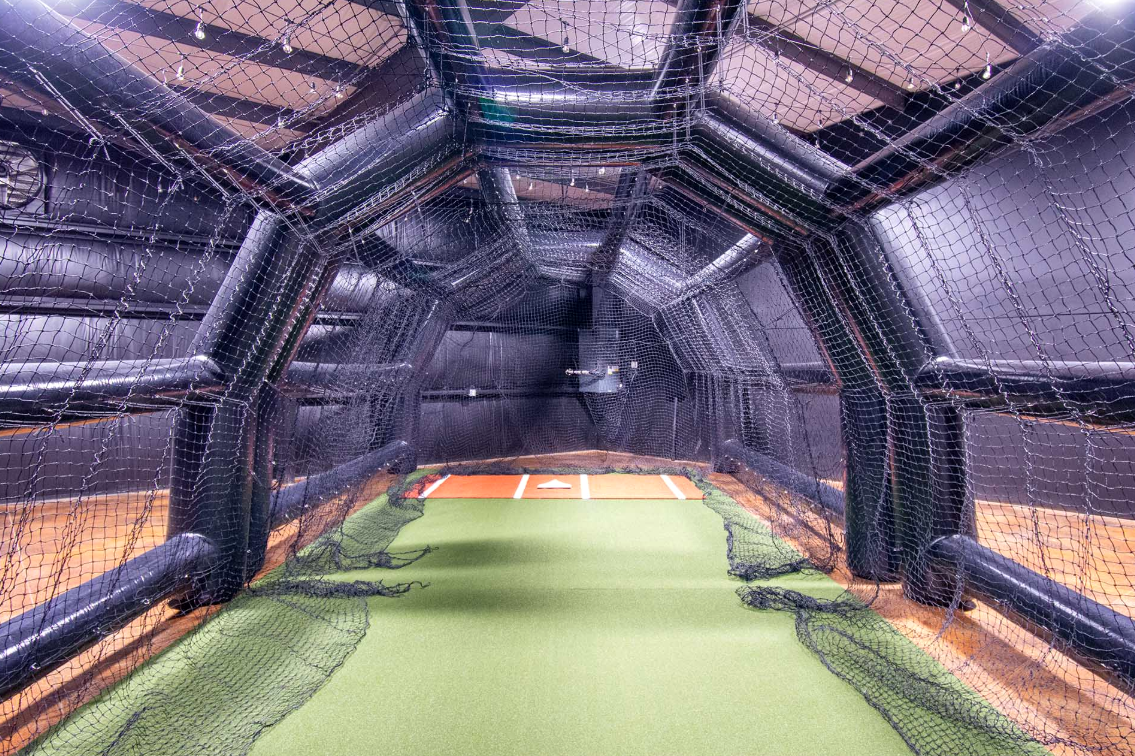
Batting cages give baseball and softball players a dedicated space to practice hitting without retrieving balls from an open field. Found at schools, sports complexes, training centers, and private homes, these enclosures contain batted balls and make repeated hitting drills easier to organize.
Choosing a batting cage involves more than selecting a net and finding somewhere to hang it. Dimensions, pitching distance, equipment placement, lighting, and safety features determine which drills a facility can accommodate. The right setup depends on the players using it, the available space, and how frequently the equipment will be used.
What Are Batting Cages and How Do They Work?
A batting cage is an enclosed training area surrounded by protective netting or impact-resistant barriers. Players hit balls delivered by a coach, pitching machine, or live pitcher, while the enclosure is designed to keep batted balls within the practice area.
Most cages have a designated hitting station, a pitching position, and netting supported by a frame or overhead suspension system. Larger facilities may also include artificial turf, protective screens, automatic ball feeders, and video analysis equipment.
Batting cages allow hitters to work on swing mechanics, timing, bat control, and consistent contact without needing an entire baseball or softball field. Common drills include tee work, soft toss, front toss, and machine pitching. Coaches can adjust pitch speed and delivery distance to target specific skills.
Baseball batting cages are typically configured for overhand pitching, although they also accommodate shorter-distance drills. Softball batting cages use similar enclosures but must account for different pitching styles. Fastpitch softball uses an underhand windmill delivery, while slowpitch softball features a high-arc pitch. These differences affect machine selection, pitching distances, and the clearance needed for certain drills.
A batting cage also makes practice easier to manage by reducing ball retrieval and separating hitters from surrounding activities. However, netting alone cannot prevent every accident. Safe equipment placement, protective gear, and supervision remain essential.
Types of Batting Cages
Batting cages come in several configurations suited to different training environments. The main differences involve installation location, structural design, portability, and available training space.
Indoor and Outdoor Batting Cages
Indoor batting cages allow year-round training regardless of weather conditions. They are commonly installed in school gyms, sports centers, converted warehouses, and dedicated baseball facilities.
Their main advantage is consistent practice conditions. Indoor facilities avoid interruptions from rain and wind, provide controlled lighting, and can accommodate equipment such as pitching simulators and swing analysis systems.
However, the building needs adequate ceiling height, ventilation, and clearance around the enclosure. Beams, lighting fixtures, and ventilation ducts must remain outside the cage’s impact zones.
Outdoor batting cages are common at schools, recreational complexes, baseball fields, and residential properties. They can accommodate longer enclosures where sufficient land is available, without the ceiling restrictions of an indoor building.
Outdoor equipment must withstand sunlight, moisture, temperature changes, and wind. UV-resistant netting, corrosion-resistant hardware, secure anchoring, and proper drainage help prevent premature deterioration. Standing water can also damage the hitting surface and create slipping hazards.
The right choice depends on local weather, available space, training schedules, and maintenance costs. Indoor cages offer predictable conditions, while outdoor installations can provide more room without requiring a dedicated building.
Fixed and Portable Batting Cages
Fixed batting cages are intended for long-term use. They typically rely on steel posts, rigid frames, or overhead cable systems to support the enclosure.
Permanent installations work particularly well for schools, baseball clubs, and commercial training centers. They can accommodate dedicated pitching stations, electrical connections, lighting, and ball collection systems without repeated assembly.
Portable batting cages are easier to move, store, or set up when needed. Depending on the model, they may feature lightweight metal frames, fiberglass supports, or collapsible netting.
These systems suit seasonal training programs, shared sports facilities, and backyard practice. Smaller models are especially useful for tee work and short-distance drills.
Portability does have limitations. Lightweight structures may provide less interior clearance and can require additional anchoring outdoors. Frames and connections should be inspected after relocation, and assembly must follow the manufacturer’s instructions.
For facilities running daily practices, a permanent installation generally offers greater convenience. Portable cages make more sense when space is shared, or the training area needs to be cleared between sessions.
Batting Cage Dimensions and Space Requirements
Batting cage dimensions depend on the sport, player age, pitching method, and available space. There is no universal regulation size for every baseball or softball training cage.
A common full-length configuration measures approximately 70 feet long, 12 to 14 feet wide, and 12 feet high. This provides room for tee work, front toss, and many machine-pitching drills, provided the equipment is positioned correctly.
Shorter cages can handle drills that do not require regulation pitching distances.
| Cage Type | Example Dimensions (L × W × H) | Common Application |
| Full-length cage | 70 × 12–14 × 12 ft | Team practice and machine pitching |
| Mid-length cage | 55 × 12 × 12 ft | General hitting drills and shorter pitching distances |
| Compact cage | 35 × 12 × 10 ft | Tee work, front toss, and limited-space training |
| Portable practice cage | Varies by model | Temporary or backyard training |
These measurements are examples rather than official standards. The usable interior space may be smaller than the cage’s overall dimensions.
In regulation baseball, the pitching distance is 60 feet, 6 inches, measured from the front edge of the pitcher’s rubber to the back point of home plate. In women’s fastpitch softball, 43 feet is standard at many collegiate and adult competition levels. Youth divisions and other formats may use shorter distances.
Training distances do not always match regulation pitching distances. Front toss and certain machine-pitching drills are performed closer to the batter, making them suitable for shorter enclosures.
The overall cage length must also accommodate space behind the hitter and around pitching equipment. A 70-foot enclosure does not necessarily provide 70 feet of usable pitching distance.
Width and height matter just as much. Hitters need enough room for a full swing without contacting the net, while overhead clearance must accommodate the intended ball trajectory. Slowpitch softball drills involving high-arc deliveries may require additional height.
Facilities with multiple cages should also provide safe entry points, clear walkways, and adequate separation between neighboring hitting areas.
Essential Batting Cage Equipment
Every batting cage needs equipment that can withstand repeated ball impacts while supporting safe, consistent practice. The main components include protective netting, a support structure, hitting equipment, and pitching accessories.
Batting cage netting forms the enclosure and helps prevent batted balls from reaching nearby players, spectators, or equipment.
Nylon and polyethylene are two common materials. Nylon is known for its strength, flexibility, and impact resistance, while polyethylene offers good moisture resistance and is widely available in UV-stabilized grades. Both can be used outdoors when properly rated for the conditions.
Netting is available in different twine gauges, mesh sizes, and constructions. Commercial facilities generally need heavier-duty materials than backyard cages because of the greater number of impacts.
Proper installation is just as important as material selection. Netting should hang with enough slack to absorb ball impacts, while maintaining sufficient clearance from walls, posts, and other rigid surfaces. The appropriate tension depends on the net’s construction and the manufacturer’s installation guidelines. Damaged mesh, unsecured edges, or gaps around access points can allow balls to escape.
Other important equipment includes:
- Support frames and suspension cables: Keep the enclosure securely positioned and maintain its intended shape.
- Pitching machines: Deliver repeatable pitches at adjustable speeds, with some models offering different pitch types.
- Protective L-screens: Help shield coaches and pitchers from line drives during batting practice.
- Batting tees: Hold stationary balls for drills focused on swing mechanics and contact points.
- Home plates and batter’s box markings: Help hitters maintain consistent positioning.
- Artificial turf or durable, non-slip sports flooring: Provide stable footing and withstand repeated use.
- Ball collection equipment: Reduces retrieval time between drills.
Pitching machines should match the sport and training level. Baseball and softball models may differ in ball compatibility, speed range, and delivery trajectory. Some machines support both sports, but buyers should confirm whether they can reproduce the pitches needed for their training programs.
Protective L-screens are especially important during coach-pitched drills. They provide a barrier against balls hit directly back toward the pitching position, although they cannot eliminate every risk. Correct placement, stable construction, and regular inspection are necessary for effective protection.
Commercial facilities may also need controlled access points, warning signs, emergency shutoffs for powered equipment, and protective barriers between adjacent cages.
When comparing equipment, consider how often it will need repairs and how much replacement parts will cost. Durable netting and reliable pitching machines can reduce long-term maintenance expenses.
How to Set Up and Maintain a Batting Cage
Start by identifying who will use the cage and what type of practice it needs to support. A facility designed for adult baseball players may require different dimensions and equipment from one intended primarily for youth softball or backyard tee work.
Training frequency also matters. A commercial cage operating throughout the day needs more durable materials and a stricter inspection schedule than a portable enclosure used occasionally.
Planning the Batting Cage Layout
First, determine how much usable space the enclosure will provide.
Measure the available length, width, and height, including overhead obstacles. Indoor installations must account for beams, ventilation ducts, lighting, and structural supports. Outdoor layouts should consider property boundaries, drainage, nearby buildings, and wind exposure.
Position the hitting station where the batter can complete a full swing without contacting the netting. Pitching machines need a stable surface and enough space for operators to load balls, adjust settings, and move safely.
For facilities with several cages, keep shared walkways outside ball-impact zones. Players entering or leaving one enclosure should not have to cross another active hitting area.
Electrical connections must be protected from moisture, ball impacts, and foot traffic. Equipment placement should also allow operators to reach machine controls without stepping into the batter’s swing path.
Installing the Frame and Netting
Permanent outdoor cages typically use anchored posts or rigid frames. The appropriate foundation depends on the structure, ground conditions, and expected wind loads.
Indoor installations may use ceiling-mounted suspension systems or freestanding frames. Any overhead mounting system must be compatible with the building’s structural capacity.
Once the supports are installed, suspend the netting according to the manufacturer’s specifications. The enclosure should cover the sides, ceiling, and rear impact area without leaving exposed openings.
Leave enough space between the net and rigid surfaces to allow it to absorb impacts without transferring the full force to nearby walls or equipment. The net should hang evenly, with tension appropriate to the installation system.
Check that doors, overlapping net panels, and other entry points close securely. All attachment points should be accessible for inspection without interfering with the training area.
Maintaining the Training Area
Regular inspections help prevent equipment failures and keep the cage safe for daily use.
Pay particular attention to sections of netting exposed to frequent impacts, especially behind the hitting station. Broken strands, enlarged mesh openings, and worn attachment points should be addressed before practice resumes.
Inspect frames, suspension cables, hooks, and anchors for corrosion, deformation, and loose connections. Outdoor structures need additional attention after storms or strong winds.
Pitching machines should be maintained according to the manufacturer’s instructions. Depending on the model, this may involve cleaning pitching wheels, inspecting electrical cables, tightening fasteners, and replacing worn parts.
Don’t overlook the hitting surface. Artificial turf needs regular cleaning, while uneven flooring and damaged sections should be repaired before they become tripping hazards.
A regular inspection schedule helps operators stay on top of maintenance:
| Frequency | Recommended Maintenance |
| Before each session | Check netting, protective screens, flooring, and equipment placement |
| Weekly | Inspect high-impact net sections and clean the hitting area |
| Monthly | Examine frame connections, cables, anchors, and pitching machine components |
| At the start and end of each season | Conduct a detailed structural inspection and replace worn materials |
| After severe weather | Inspect outdoor frames, anchoring, and netting before resuming practice |
Busy facilities should inspect their equipment more frequently, particularly when cages are used for high-speed machine pitching.
Safe operating procedures are equally important. Only one batter should occupy an active hitting station, and other participants must remain outside the swing area.
Ball retrieval and equipment adjustments should take place only after pitching has stopped. Anyone operating a pitching machine must understand its controls and emergency shutdown procedures.
A properly maintained batting cage can serve players for years. Choosing dimensions that suit the intended drills, installing durable materials, and addressing wear early are more valuable than adding equipment the facility rarely uses.
FAQ
What are batting cages used for?
Batting cages provide enclosed spaces for baseball and softball hitting practice. They allow players to complete repeated drills using batting tees, coach pitching, or pitching machines without needing a full playing field.
How much space do you need for a batting cage?
A full-length cage commonly measures around 70 feet long, 12 to 14 feet wide, and 12 feet high. Smaller configurations work for short-distance drills, provided there is adequate clearance for the batter, pitching equipment, and safe access.
Can baseball and softball players use the same batting cage?
Yes. The same enclosure can accommodate both sports, although pitching distances, ball sizes, and machine settings must be adjusted. Slowpitch softball may also require greater overhead clearance for high-arc deliveries.
What is the best netting material for batting cages?
Nylon and polyethylene are common choices. Nylon offers strength and flexibility, while UV-stabilized polyethylene is well suited to many outdoor applications. Twine thickness, mesh construction, and expected usage are also important selection factors.
Can you install a batting cage in your backyard?
Yes, if the property has sufficient space and the installation meets local requirements. Portable cages are often practical for residential use. The enclosure should be securely anchored and positioned away from windows and neighboring properties.
Do batting cages require regular maintenance?
Yes. Netting, frames, pitching machines, and flooring all need periodic inspection. Maintenance frequency depends on usage and environmental exposure, with additional checks recommended after severe weather.